
The Outsiders
Click here for more
articles and past favorites
©By Grady M. Towers (From The Prometheus Society's Journal, Gift of Fire Issue No. 22,
April 1987. This article was re-issued in Issue 72, March 95.) His
name was William James Sidis, and his IQ was estimated at between 250
and 300 [8, p. 283]. At eighteen months he could read The New York
Times, at two he taught himself Latin, at three he learned Greek. By
the time he was an adult he could speak more than forty languages and
dialects. He gained entrance to Harvard at eleven, and gave a lecture
on four-dimensional bodies to the Harvard Mathematical Club his first
year. He graduated cum laude at sixteen, and became the youngest
professor in history. He deduced the possibility of black holes more
than twenty years before Subrahmanyan Chandrasekhar published An
Introduction to the Study of Stellar Structure. His life held
possibilities for achievement that few people can imagine. Of all the
prodigies for which there are records, his was probably the most
powerful intellect of all. And yet it all came to nothing. He soon gave
up his position as a professor, and for the rest of his life wandered
from one menial job to another. His experiences as a child prodigy had
proven so painful that he decided for the rest of his life to shun
public exposure at all costs. Henceforth, he denied his gifts, refused
to think about mathematics, and above all refused to perform as he had
been made to do as a child. Instead, he devoted his intellect almost
exclusively to the collection of streetcar transfers, and to the study
of the history of his native Boston. He worked hard at becoming a
normal human being, but never entirely succeeded. He found the concept
of beauty, for example, to be completely incomprehensible, and the idea
of sex repelled him. At fifteen he took a vow of celibacy, which he
apparently kept for the remainder of his life, dying a virgin at the
age of 46. He wore a vest summer and winter, and never learned to bathe
regularly. A comment that Aldous Huxley once made about Sir Isaac
Newton might equally have been said of Sidis. For the price Newton had to pay for being a supreme
intellect was that he was incapable of friendship, love, fatherhood,
and many other desirable things. As a man he was a failure; as a
monster he was superb [5, p. 2222]. There was a time when all precocious children were thought to
burn out the same way that Sidis did. The man most responsible for
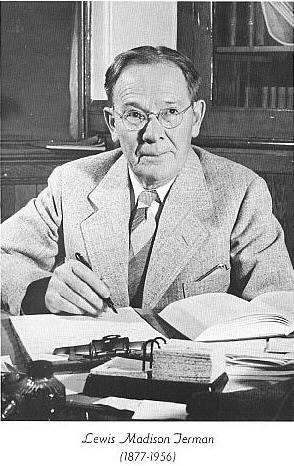
changing this belief was Lewis M. Terman. Between 1900 and 1920 he was
able to carry out a study of about a hundred gifted children, and his
observations convinced him that many of the traditional beliefs about
the gifted were little more than superstitions. To confirm these
observations, he obtained a grant from the Commonwealth Fund in 1922,
and used it to sift a population of more than a quarter of a million
children, selecting out all those with IQs above 140 for further study.
That group has been monitored continuously ever since. Many of the
previously held beliefs about the gifted did indeed turn out to be
false. The gifted are not weak or sickly, and although the incidence of
myopia is greater among them, they are generally thought to be better
looking than their contemporaries: They are not nerds. Nevertheless, in his rush to dispel the erroneous
beliefs about the gifted, Terman sometimes made claims not supported by
his own data. In fact, in some cases, the data suggests that exactly
the opposite conclusion should have been drawn. Terman's own data shows
that there is a definite connection between measured intelligence and
mental and social maladjustment. The consequences of misinterpreting
these data are so grave that it will pay to re-examine them in some
detail. Terman's longitudinal research on the gifted included a
constant assessment of mental health and social adjustment. Subjects
were classified into three categories: satisfactory adjustment, some
maladjustment, and serious maladjustment. Terman defined these
categories in the following way. 1. Satisfactory. Subjects classified in this category were
essentially normal; i.e., their "desires, emotions, and interests were
compatible with the social standards and pressures" of their group.
Everyone, of course, has adjustment problems of one kind or another.
Satisfactory adjustment as here defined does not mean perfect
contentment and complete absence of problems, but rather the ability to
cope adequately with difficulties in the personal make-up or in the
subject's environment. Worry and anxiety when warranted by the
circumstances, or a tendency to be somewhat high strung or
nervous--provided such a tendency did not constitute a definite
personality problem--were allowed in this category. 2. Some
maladjustment. Classified here were subjects with excessive feelings of
inadequacy or inferiority, nervous fatigue, mild anxiety neurosis, and
the like. The emotional conflicts, nervous tendencies and social
maladjustments of these individuals, while they presented definite
problems, were not beyond the ability of the individual to handle, and
there was no marked interference with social or personal life or with
achievement. Subjects whose behavior was noticeably odd or freakish,
but without evidence of serious neurotic tendencies, were also
classified in this category. 3. Serious maladjustment. a.) Classified
as 3a were subjects who had shown marked symptoms of anxiety, mental
depression, personality maladjustment, or psychopathic personality.
This classification also includes subjects who had suffered a "nervous
breakdown," provided the condition was not severe enough to constitute
a psychosis. Subjects with a previous history of serious maladjustment
or nervous breakdown (without psychosis) were included here even though
their adjustment at the time of rating may have been entirely
satisfactory. b.) Classified as 3b were those subjects who had at any
time suffered a complete mental breakdown requiring hospitalization,
whatever their condition at the time of rating. In the majority of
cases the subjects were restored to reasonably good mental health after
a brief period of hospital care [6, pp. 99-101]. In 1940, when the group was about 29 years of age, a large
scale examination was carried out. Included in that examination was a
high level test of verbal intelligence, designated at that time the
Concept Mastery, but later re-named the Concept Mastery test form A.
Terman found the following relationship between adjustment and verbal
intelligence. (These are raw scores, not IQs.) CMT-A [6, p. 115] N The data show three things. First, that there is
a definite trend for the maladjusted to make higher scores on the
Concept Mastery test. Second, that women show symptoms of maladjustment
at lower scores than men. And third, that 21 percent of the men and 18
percent of the women showed at least some form of maladjustment. During 1950-52, when the group was approximately 41 years old,
another examination was made using a new test, the Concept Mastery test
form T. Test scores were again compared to assessments of adjustment.
(CMT-T scores are not interchangeable with CMT-A scores. They have
different means and standard deviations.) CMT-T [7, p. 50] N Similar conclusions can be drawn from these data as well.
Again, there is a definite trend shown for the maladjusted to make
higher scores than the satisfactorily adjusted. Again, women show
symptoms of maladjustment at lower scores than men. But the most
alarming thing of all is that the percentage of maladjustment shown for
both sexes rose in the 12 years since the previous examination. The
percentage of men showing maladjustment having risen from 21 percent to
29 percent, and the figure for women having risen from 18 percent to 33
percent! Nearly double what it was before! How did Terman interpret these data? Terman states: Although severe mental maladjustment is in general somewhat
more common among subjects who score high on the Concept Mastery test,
many of the most successful men of the entire group also scored high on
this test [7, p. 50]. In other words, Terman deliberately tried to give the
impression that the relationship between verbal intelligence and mental
and social maladjustment was weak and unreliable. He did this by
misdirection. He gave a truthful answer to an irrelevant question.
Terman failed to realize that a small difference in means between two
or more distributions can have a dramatic effect on the percentage of
each group found at the tails of the distribution. The relevant
questions should have been "what is the percentage of maladjustment
found at different levels of ability, and does this show a trend?"
Terman's data can be used to find answers to these questions. The method used to solve this problem is a relatively simple
one but tedious in detail. (See appendix.) The results, however, are
easy to understand. Using CMT-T scores for men as an illustration, and
pooling the data for some maladjustment and serious maladjustment, the
following percentages can be obtained. PERCENTAGE OF MEN SHOWING SOME OR SERIOUS
MALADJUSTMENT AT SIX LEVELS OF ABILITY CMT-T Percent Maladjusted < 97.8 13 97.8 - 117.1 18 117.1 - 136.4 25 136.4 - 155.7 31 155.7 - 175 38 > 175 45 By comparison, the Triple Nine Society averages 155.16 on the
CMT-T, and the average score for Prometheus Society members is 169.95
[1, 2]. The implications are staggering, especially when it is realized
that these percentages do not include women, who show more
maladjustment at lower CMT-T scores than men do. Perhaps this is one of
the reasons why super high IQ societies suffer so much from schisms and
a tendency towards disintegration. In any event, one thing is certain.
The currently accepted belief that verbal intelligence is unrelated to
maladjustment is clearly a myth. Nevertheless, while Terman's data do provide a prima facie
case for a connection between verbal intelligence and maladjustment,
they fail to explain the causal mechanism involved. To obtain such
insight requires close observation by a gifted observer. Fortunately,
those insights are available to us in Leta S. Hollingworth's book,
Children above 180 IQ. Hollingworth not only observed her subjects as
children, she also continued to maintain some contact with them after
they had reached maturity. So although her book is ostensibly about
children, it is in fact laced throughout by her observations on
exceptionally gifted adults as well. Before examining Hollingworth's findings, however, it is
necessary to explain how childhood IQs are related to adult mental
ability. As a child ages, his IQ tends to regress to the mean of the
population of which he is a member. This is partly due to the imperfect
reliability of the test, and partly due to the uneven rate of
maturation. The earlier the IQ is obtained, and the higher the score,
the more the IQ can be expected to regress by the time the child
becomes an adult. So although Hollingworth's children were all selected
to have IQs above 180, their adult status was not nearly so high. In
fact, as adults, there's good reason to believe that their abilities
averaged only slightly above that of the average Triple Nine member.
Evidence for this conjecture comes from the Terman research data.
Terman observed the following relationship between childhood IQs on the
Stanford-Binet and adult status on the Concept Mastery test form T. CONCEPT MASTERY SCORES
ACCORDING TO CHILDHOOD STANFORD-BINET IQ [7, p. 58] The average childhood IQ score for those with childhood IQs
above 170 was 177.7 for men, and 177.6 for women. That's quite close to
the 180 cutoff used by Leta Hollingworth in selecting her subjects.
Note that Terman's subjects who scored above 170 IQ as children
averaged 155.8 on the CMT-T at age 41, a score quite close to the
155.16 made by the average Triple Nine member. Such a close match makes
it reasonable to generalize Hollingworth's findings to members of both
the Triple Nine Society and the Prometheus Society. Hollingworth identified a number of adjustment problems caused
by school acceleration. As this is rarely practiced in today's
educational system, these are no longer problems and will not be
discussed. There still remain, however, four adjustment problems that
continue to perplex the gifted throughout their lives, two applying to
all levels of giftedness, and two applying almost exclusively to the
exceptionally gifted--i.e. those with childhood IQs above 170, or adult
Concept Mastery test (T) scores above 155. One of the problems faced by all gifted persons is learning to
focus their efforts for prolonged periods of time. Since so much comes
easily to them, they may never acquire the self-discipline necessary to
use their gifts to the fullest. Hollingworth describes how the habit
begins. Where the gifted child drifts in the school unrecognized,
working chronically below his capacity (even though young for his
grade), he receives daily practice in habits of idleness and
daydreaming. His abilities never receive the stimulus of genuine
challenge, and the situation tends to form in him the expectation of an
effortless existence [3, p. 258]. But if the "average" gifted child tends to acquire bad
adjustment habits in the ordinary schoolroom, the exceptionally gifted
have even more problems. Hollingworth continues: Children with IQs up to 150 get along in the ordinary course
of school life quite well, achieving excellent marks without serious
effort. But children above this mental status become almost intolerably
bored with school work if kept in lockstep with unselected pupils of
their own age. Children who rise above 170 IQ are liable to regard
school with indifference or with positive dislike, for they find
nothing in the work to absorb their interest. This condition of
affairs, coupled with the supervision of unseeing and unsympathetic
teachers, has sometimes led even to truancy on the part of gifted
children [3, p. 258]. A second adjustment problem faced by all gifted persons is due
to their uncommon versatility. Hollingworth says: Another problem of development with reference to occupation
grows out of the versatility of these children. So far from being
one-sided in ability and interest, they are typically capable of so
many different kinds of success that they may have difficulty in
confining themselves to a reasonable number of enterprises. Some of
them are lost to usefulness through spreading their available time and
energy over such a wide array of projects that nothing can be finished
or done perfectly. After all, time and space are limited for the gifted
as for others, and the life-span is probably not much longer for them
than for others. A choice must be made among the numerous
possibilities, since modern life calls for specialization [3, p. 259]. A third problem faced by the gifted is learning to suffer
fools gladly. Hollingworth notes: A lesson which many gifted persons never learn as long as they
live is that human beings in general are inherently very different from
themselves in thought, in action, in general intention, and in
interests. Many a reformer has died at the hands of a mob which he was
trying to improve in the belief that other human beings can and should
enjoy what he enjoys. This is one of the most painful and difficult
lessons that each gifted child must learn, if personal development is
to proceed successfully. It is more necessary that this be learned than
that any school subject be mastered. Failure to learn how to tolerate
in a reasonable fashion the foolishness of others leads to bitterness,
disillusionment, and misanthropy [3, p. 259]. The single greatest adjustment problem faced by the gifted,
however, is their tendency to become isolated from the rest of
humanity. This problem is especially acute among the exceptionally
gifted. Hollingworth says: This tendency to become isolated is one of the most important
factors to be considered in guiding the development of personality in
highly intelligent children, but it does not become a serious problem
except at the very extreme degrees of intelligence. The majority of
children between 130 and 150 find fairly easy adjustment, because
neighborhoods and schools are selective, so that like-minded children
tend to be located in the same schools and districts. Furthermore, the
gifted child, being large and strong for his age, is acceptable to
playmates a year or two older. Great difficulty arises only when a
young child is above 160 IQ. At the extremely high levels of 180 or 190
IQ, the problem of friendships is difficult indeed, and the younger the
person the more difficult it is. The trouble decreases with age because
as persons become adult, they naturally seek and find on their own
initiative groups who are like-minded, such as learned societies [3, p.
264]. Hollingworth points out that the exceptionally gifted do not
deliberately choose isolation, but are forced into it against their
wills. These superior children are not unfriendly or ungregarious by
nature. Typically they strive to play with others but their efforts are
defeated by the difficulties of the case... Other children do not share
their interests, their vocabulary, or their desire to organize
activities. They try to reform their contemporaries but finally give up
the struggle and play alone, since older children regard them as
"babies," and adults seldom play during hours when children are awake.
As a result, forms of solitary play develop, and these, becoming fixed
as habits, may explain the fact that many highly intellectual adults
are shy, ungregarious, and unmindful of human relationships, or even
misanthropic and uncomfortable in ordinary social intercourse [3, p.
262]. But if the exceptionally gifted is isolated from his
contemporaries, the gulf between him and the adult authorities in his
life is even deeper. The very gifted child or adolescent, perceiving the illogical
conduct of those in charge of his affairs, may turn rebellious against
all authority and fall into a condition of negative suggestibility--a
most unfortunate trend of personality, since the person is then unable
to take a cooperative attitude toward authority. A person who is highly
suggestible in a negative direction is as much in bondage to others
around him as is the person who is positively suggestible. The social
value of the person is seriously impaired in either case. The gifted
are not likely to fall victims to positive suggestion but many of them
develop negativism to a conspicuous degree [3, p 260]. Anyone reading the super high IQ journals is aware of the
truth of this statement. Negative individuals abound in every high IQ
society. Hollingworth distilled her observations into two ideas that
are among the most important ever discovered for the understanding of
gifted behavior. The first is the concept of an optimum adjustment
range. She says: All things considered, the psychologist who has observed the
development of gifted children over a long period of time from early
childhood to maturity, evolves the idea that there is a certain
restricted portion of the total range of intelligence which is most
favorable to the development of successful and well-rounded personality
in the world as it now exists. This limited range appears to be
somewhere between 125 and 155 IQ. Children and adolescents in this area
are enough more intelligent than the average to win the confidence of
large numbers of their fellows, which brings about leadership, and to
manage their own lives with superior efficiency. Moreover, there are
enough of them to afford mutual esteem and understanding. But those of
170 IQ and beyond are too intelligent to be understood by the general
run of persons with whom they make contact. They are too infrequent to
find congenial companions. They have to contend with loneliness and
personal isolation from their contemporaries throughout the period of
their immaturity. To what extent these patterns become fixed, we cannot
yet tell [3, p. 264]. Hollingworth's second seminal idea is that of a "communication
range." She does not state this explicitly, but it can be inferred from
some of her comments on leadership. Observation shows that there is a direct ratio between the
intelligence of the leader and that of the led. To be a leader of his
contemporaries a child must be more intelligent but not too much more
intelligent than those to be led... But generally speaking, a
leadership pattern will not form--or it will break up--when a
discrepancy of more than about 30 points of IQ comes to exist between
leader and led [3, p. 287]. The implication is that there is a limit beyond which genuine
communication between different levels of intelligence becomes
impossible. To say that a child or an adult is intellectually isolated
from his contemporaries is to say that everyone in his environment has
an IQ at least 30 points different from his own. Knowing only a
person's IQ, then, is not enough to tell how well he's likely to cope
with his environment. Some knowledge of the intellectual level of his
environment is also necessary. If the optimum range of intelligence lies between 125 and 155
IQ, as Hollingworth suggests, then it follows that 155 can be thought
of as a threshold separating an optimum adjustment zone below it from a
suboptimum range above it. Other psychologists have also noticed how
this score tends to divide people into two naturally occurring
categories. Among these is one of the doyens of psychometrics, David
Wechsler. He comments: The topics of genius and degeneration are only special cases
of the more general problem involved in the evaluation of human
capacities, namely the quantitative versus qualitative. There are those
who insist that all differences are qualitative, and those who with
equal conviction maintain that they are exclusively quantitative. The
true answer is that they are both. General intelligence, for example,
is undoubtedly quantitative in the sense that it consists of varying
amounts of the same basic stuff (e.g., mental energy) which can be
expressed by continuous numerical measures like intelligence Quotients
or Mental-Age scores, and these are as real as any physical
measurements are. But it is equally certain that our description of the
difference between a genius and an average person by a statement to the
effect that he has an IQ greater by this or that amount, does not
describe the difference between them as completely or in the same way
as when we say that a mile is much longer than an inch. The genius (as
regards intellectual ability) not only has an IQ of say 50 points more
than the average person, but in virtue of this difference acquires
seemingly new aspects (potentialities) or characteristics. These
seemingly new aspects or characteristics, in their totality, are what
go to make up the "qualitative" difference between them [9, p. 134]. Wechsler is saying quite plainly that those with IQs above 150
are different in kind from those below that level. He is saying that
they are a different kind of mind, a different kind of human being. This subjective impression of a difference in kind also
appears to be fairly common among members of the super high IQ
societies themselves. When Prometheus and Triple Nine members were
asked if they perceived a categorical difference between those above
this level and others, most said that they did, although they also said
that they were reluctant to call the difference genius. When asked what
it should be called, they produced a number of suggestions, sometimes
esoteric, sometimes witty, and often remarkably vulgar. But one term
was suggested independently again and again. Many thought that the most
appropriate term for people like themselves was Outsider. The feeling of estrangement, or at least detachment, from
society at large is not merely subjective illusion. Society is not
geared to deal effectively with the exceptionally gifted adult because
almost nothing objective is known about him. It is a commonplace
observation that no psychometric instrument can be validly used to
evaluate a person unless others like him were included in the test's
norming sample. Yet those with IQs above 150 are so rare that few if
any were ever included in the norming sample of any of the most
commonly used tests, tests like the Strong-Campbell Interest Inventory,
the Kuder Vocational Preference Record, the MMPI and so on. As a
consequence, objective self-knowledge for the exceptionally gifted is
nearly impossible to obtain. What he most needs to know is not how he
differs from ordinary people--he is acutely aware of that--but how he
is both like and unlike those of his own kind. The most commonly used
tests can't provide that knowledge, so he is forced to find out in more
roundabout ways. It is his attempts to find answers to these questions
that may explain the emergence of the super high IQ societies. Where
else can he find peers against which to measure himself? There appear to be three sorts of childhoods and three sorts
of adult social adaptations made by the gifted. The first of these may
be called the committed strategy. These individuals were born into
upper middle class families, with gifted and well educated parents, and
often with gifted siblings. They sometimes even had famous relatives.
They attended prestigious colleges, became doctors, lawyers,
professors, or joined some other prestigious occupation, and have
friends with similar histories. They are the optimally adjusted. They
are also the ones most likely to disbelieve that the exceptionally
gifted can have serious adjustment problems. The second kind of social adaptation may be called the
marginal strategy. These individuals were typically born into a lower
socio-economic class, without gifted parents, gifted siblings, or
gifted friends. Often they did not go to college at all, but instead
went right to work immediately after high school, or even before. And
although they may superficially appear to have made a good adjustment
to their work and friends, neither work nor friends can completely
engage their attention. They hunger for more intellectual challenge and
more real companionship than their social environment can supply. So
they resort to leading a double life. They compartmentalize their life
into a public sphere and a private sphere. In public they go through
the motions of fulfilling their social roles, whatever they are, but in
private they pursue goals of their own. They are often omnivorous
readers, and sometimes unusually expert amateurs in specialized
subjects. The double life strategy might even be called the genius
ploy, as many geniuses in history have worked at menial tasks in order
to free themselves for more important work. Socrates, you will remember
was a stone mason, Spinoza was a lens grinder, and even Jesus was a
carpenter. The exceptionally gifted adult who works as a parking lot
attendant while creating new mathematics has adopted an honored way of
life and deserves respect for his courage, not criticism for failing to
live up to his abilities. Those conformists who adopt the committed
strategy may be pillars of their community and make the world go
around, but historically, those with truly original minds have more
often adopted the double life tactic. They are ones among the gifted
who are most likely to make the world go forward. And finally there are the dropouts. These sometimes bizarre
individuals were often born into families in which one or more of the
parents were not only exceptionally gifted, but exceptionally
maladjusted themselves. This is the worst possible social environment
that a gifted child can be thrust into. His parents, often driven by
egocentric ambitions of their own, may use him to gratify their own
needs for accomplishment. He is, to all intents and purposes, not a
living human being to them, but a performing animal, or even an
experiment. That is what happened to Sidis, and may be the explanation
for all those gifted who "burn out" as he did. (Readers familiar with
the Terman study will recognize the committed strategy and the marginal
strategy as roughly similar to the adjustment patterns of Terman's A
and C groups.) If the exceptionally gifted adult with an IQ of 150, or 160,
or 170 has problems in adapting to his world, what must it have been
like for William James Sidis, whose IQ was 250 or more? Aldous Huxley once wrote: Perhaps men of genius are the only true men. In all the
history of the race there have been only a few thousand real men. And
the rest of us--what are we? Teachable animals. Without the help of the
real man, we should have found out almost nothing at all. Almost all
the ideas with which we are familiar could never have occurred to minds
like ours. Plant the seeds there and they will grow; but our minds
could never spontaneously have generated them [4, p. 2242]. And so we see that the explanation for the Sidis tragedy is
simple. Sidis was a feral child; a true man born into a world filled
with animals--a world filled with us.The Outsiders
Men
Women
Mean
S.D.
N
Mean
S.D.
Satisfactory adjustment
407
95.2
30.9
344
92.4
28.7
Some maladjustment
91
108.0
31.2
59
98.6
25.4
Serious maladjustment
18
119.5
23.6
17
108.6
27.1
Men
Women
Mean
S.D.
N
Mean
S.D.
Satisfactory adjustment
391
136.4
26.2
303
130.8
27.7
Some maladjustment
120
145.6
26.1
117
138.1
26.4
Serious maladjustment
40
152.8
23.8
33
140.0
29.6
IQ
N
CMT-T
135-139
41
114.2
140-149
344
131.8
150-159
200
136.5
160-169
70
146.2
> 170
48
155.8
o o o o
Some of those reading this paper may find the portrait painted here to be completely incredible. Their own experiences were nothing at all like those described, nor were those of most of their gifted friends. But the point of this article is not that there's some special hazard in having an exceptional IQ: There's not. The point is that the danger lies in having an exceptional IQ in an environment completely lacking in intellectual peers. It's the isolation that does the damage, not the IQ itself.
It is the belief of this author that the super high IQ societies were created primarily by those who have adopted the marginal strategy, and by rights ought to be aimed at fulfilling the needs of this subdivision of the exceptionally gifted. It's obvious from reading the journals that those who have followed the committed strategy rarely participate in society affairs, rarely write for the various journals, and indeed have little need to belong to such a group. They have far more productive outlets for their talents. It's the exceptionally gifted adult who feels stifled that stands most in need of a high IQ society. The tragedy is that none of the super high IQ societies created thus far have been able to meet those needs, and the reason for this is simple. None of these groups is willing to acknowledge or come to terms with the fact that much of their membership belong to the psychological walking wounded. This alone is enough to explain the constant schisms that develop, the frequent vendettas, and the mediocre level of their publications. But those are not immutable facts; they can be changed. And the first step in doing so is to see ourselves as we are.
Copyright ©
2001-2005 The
Prometheus Society. All rights reserved.
Please note that Gift of Fire
sample journal issues are no longer publicly available on this site due
to privacy issues. Click on the articles
link to view sample articles. Please refer to "Membership and/or
Subscription Fees and Benefits" on the Prometheus Society home page
for information on how to subscribe to the "print and online" or "print
only" edition of Gift of Fire.
Please contact the Prometheus
Society Internet Officer, Karyn S. Huntting, if you have comments
or questions about this site.