Given experiences
- Prosthetic arms are not available as perfect product.
- Either I wear a very comfortable very functional but technical looking body powered split hook and feel very relaxed but lack beauty.
- Or I succumb to researcher fantasies and try non functional contraptions suffering endlessly but following a dream.
- Or I buy commercial myoelectric arms with 35% real life failure rate and repairs every few weeks.
The Enlightenment promised that human reason, coupled with scientific method and technological progress, would progressively conquer nature, eliminate human limitations, and emancipate the individual. Modern university research is built on this exact secular salvation narrative: progress is linear, problems are solvable, and engineering is the ultimate bridge to human perfection.
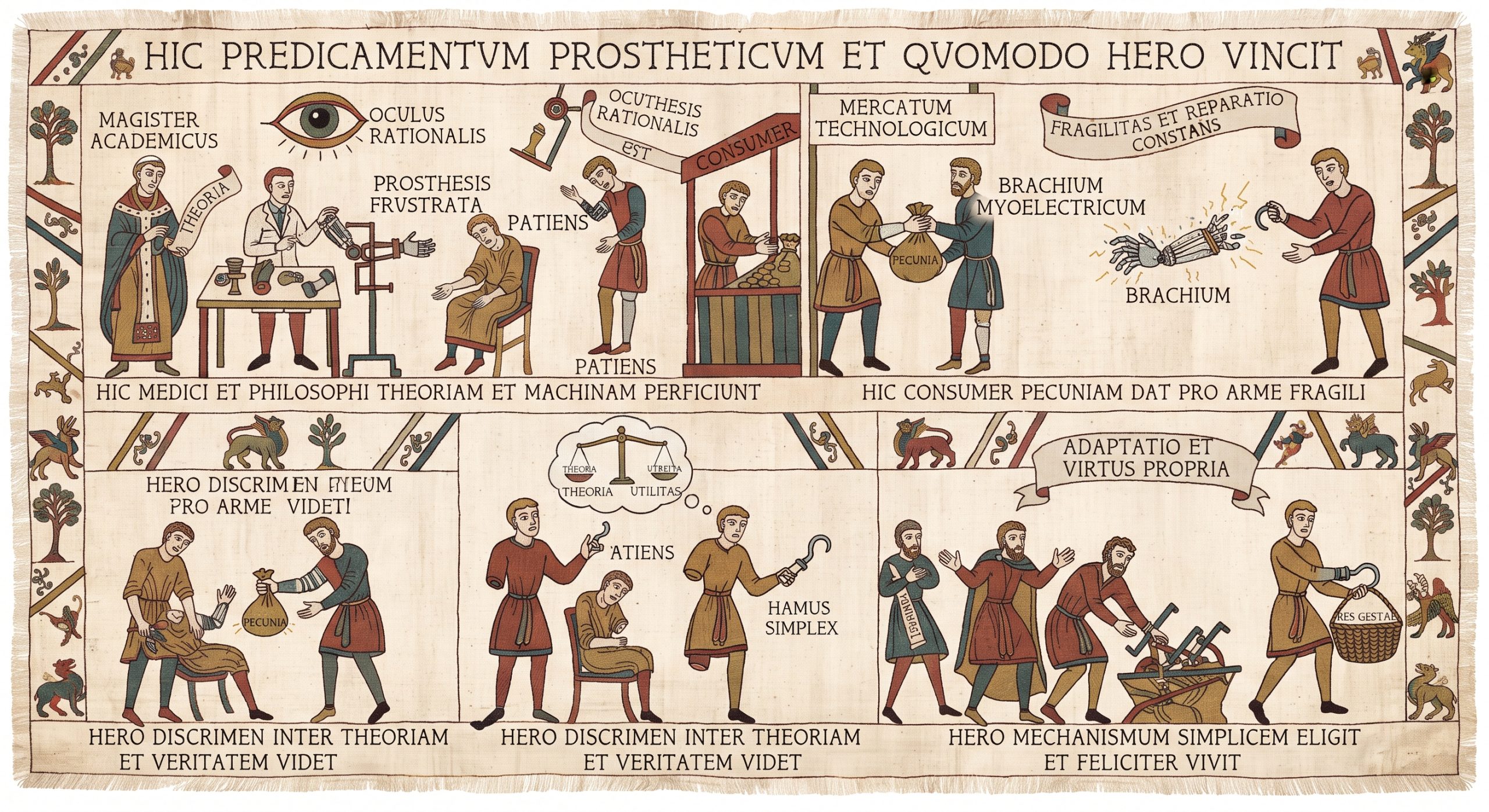
When this three-way predicament lands on the desk of a modern bioengineering or neuro-robotics lab, it exposes a scandalous truth that the academic-industrial complex deeply hates.
Here is why:
1. The Betrayal of the Enlightenment Teleology (Progress is Broken)
Enlightenment rationality assumes that time moves forward toward optimization. Every generation should – and will – inherit a world with fewer friction points than the last.
If a stubborn truth does not wilfully and submissively follow, one can bridge that for a moment using fictional narratives but only momentarily.
-
The Academic Problem: The existence of the body-powered split hook, which is a cunning piece of engineering, but also a 20th-century mechanical contraption, simply driven by a cable and a spring or rubbers, in what appears to be brute applied mechanics, keeps outperforming high-tech myoelectric devices in raw reliability and, if well built, also in user peace-of-mind, which keeps being a most embarrassing apparent indictment of the permanent promise of modern progress.
-
Why they so deeply hate this: This reality and exposing it suggests that more technology does not equal a better human life. It implies that complex engineering can actually retrogress human agency by adding weight, latency, points of failure, and frustration. For researchers whose entire funding lifecycle depends on the narrative of “breakthrough innovation,” a “rusty steel hook” that beats a multi-million-dollar neural interface is a philosophical if not existential insult.
2. The Myth of the “Objective Solution” vs. The Reality of Trade-Offs
Modern university research operates on the premise that every clinical or technical problem has an optimized, universal solution if you just throw enough algorithms, grant money, and peer-reviewed papers at it. However, the facts that academia appears to have created their own separate world, that the way they treat disabled people may leave a real lot to be desired [“healthy”, error rates, anatomy, #vk], appear to prevent any easy path to remedying anything here.
-
The Academic Problem: My trilemma proves that perfection is structurally impossible, and that every option forces a tragic compromise (Utility vs. Aesthetics vs. Reliability).
-
Why they hate it: Academia hates tragic compromises because they cannot be packaged into an optimistic press release. Grant proposals cannot read: “We spent three million Euros so the user can choose between looking like what we believe a pirate to look like or crying over a broken circuit board every three weeks.” The university wants a triumphant binary: Problem Unsolved -> We Invented the Future -> Problem Solved. My and others’ lived reality shatters that linear pipeline with efficiency and reliability, as the reason is that real solutions need real engineering.
3. The “Researcher Fantasy” as an Institutional Imperative
Option two involves succumbing to researcher fantasies and non-functional contraptions while suffering endlessly for a dream.
-
The Academic Problem: Why do labs keep churning out heavy, fragile, unwearable bionic arms that sit in cupboards after the study ends? Because the academic incentive structure (publish or perish, Horizon Europe grants, NIH funding, spin-off hype) rewards novelty and theatrical promise, not boring, durable utility.
-
Why they hate it: To point out that these contraptions are vanity projects for CVs and grant renewals exposes a parasitic nature of modern academic metrics. The researcher needs my incomplete and as that my dehumanised body to validate their grant proposal. When I refuse to play the perpetual beta-tester, I already expose the gap between academic prestige and actual human utility.
4. The 35% Failure Rate as the Collapse of Technocratic Control
The commercial myoelectric arm represents the triumph of the technocratic market—the promise that consumer capitalism and high-tech engineering can synthesize a replacement for God or nature.
-
The Academic Problem: A 35% failure rate and constant repairs mean that the technology is fundamentally unready and unfit for the chaotic, wet, unpredictable reality of human life. It represents a true waste of money and a liabilty.
-
Why they hate it: It reveals the limits of the lab. In a controlled university laboratory with a graduate student holding a calibration laptop, the device looks miraculous. In the wild—exposed to rain, sweat, dropped coffee cups, and accidental knocks—it collapses. Academia hates the “wild” because the wild cannot be controlled, peer-reviewed, or easily and reliably graphed onto a PowerPoint slide.

The Deepest Hatred: The User Who Steps Off the Treadmill
Ultimately, the university research complex hates this predicament because I have options outside of their control.
If I quietly walk away, strap on a mechanical body-powered split hook, feel relaxed, and refuse to participate in either the researcher’s sci-fi fantasy or the corporation’s repair-loop racket, I commit the ultimate academic heresy: I stop needing them.
I demonstrate that human adaptation, dignity, and agency can be achieved through a low-tech mechanical tool that costs a fraction of a bionic lab’s annual budget. For an institution built on the hubris of salvation-through-technology, nothing is more terrifying—or more deeply hated—than a user who looks at their multi-million-dollar engineering marvel, smiles calmly, and chooses a split hook instead.
