Given experiences
- Prosthetic arms are not available as perfect product.
- Either I wear a very comfortable very functional but technical looking body powered split hook and feel very relaxed but lack beauty.
- Or I succumb to researcher fantasies and try non functional contraptions suffering endlessly but following a dream.
- Or I buy commercial myoelectric arms with 35% real life failure rate and repairs every few weeks.
To analyze my prosthetic predicament through the lens of Ayn Rand’s ethical egoism, we must strip away all notions of collective compromise, societal expectations, and altruistic sacrifice.
For Rand, ethics is not about serving a “greater good,” playing a medical guinea pig out of a sense of humanitarian duty, or suffering to appease public aesthetics. The only standard of moral value is man’s life—the life proper to a rational being—where my ultimate purpose is my own happiness, achieved through the exercise of independent reason, productivity, and self-preservation.
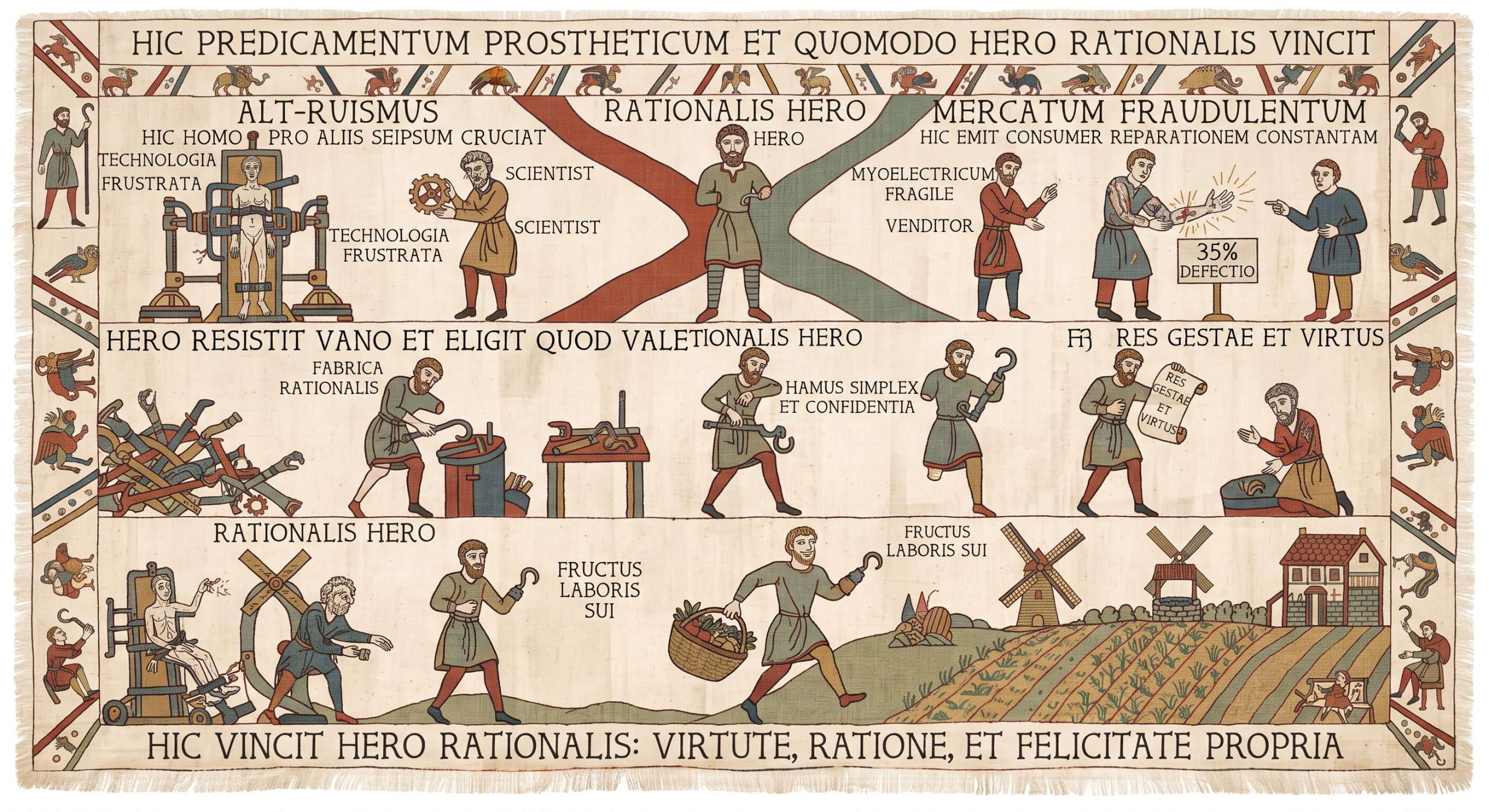
Evaluating my three choices through objectivist philosophy yields a clear perspective on my options:
1. The Body-Powered Split Hook: The Calculus of Rational Efficiency
“Either I wear a very comfortable, very functional, but technical looking body powered split hook and feel very relaxed but lack beauty.”
From an Objectivist standpoint, man qua man survives by the use of his mind and reality-oriented action. A tool’s primary moral purpose is to extend my efficacy as a living, productive agent, not to serve as a passive ornament for the evaluation of others.
-
The Virtues of Rational Production and Independence: The body-powered split hook works. It relies on mechanics, physics, and my own physical agency—not on batteries, fragile microchips, or corporate maintenance loops. It respects reality: I have an amputation, and this mechanical tool interfaces with it reliably. It requires no mystical faith, only cause-and-effect.
-
Feeling “Very Relaxed”: This psychological state is the natural emotional byproduct of acting rationally. When a tool serves my purpose without demanding constant irrational maintenance, my mind is free from chronic friction.
-
The “Lack of Beauty” Fallacy: Rand wrote extensively on art and aesthetics, arguing that true beauty must be an expression of man’s highest potential and values, not an imitation of arbitrary social norms. If society (the collective “Other”) defines beauty as a biological illusion that I must fake, rejecting that definition is a rational act of independence. A functional tool worn honestly is infinitely more “aesthetic” in an Objectivist sense than a fragile, deceptive illusion.
-
Verdict: High alignment with rational self-interest, provided I reject the unearned guilt of not matching collective aesthetic standards.
2. The Researcher Fantasies: The Immorality of Self-Sacrifice for an Illusion
“Or I succumb to researcher fantasies and try non functional contraptions suffering endlessly but following a dream.”
To Rand, the supreme moral crime is self-sacrifice—sacrificing my actual, present, rational life and happiness to an unproven future, a collective goal, or a mystic “ideal.”
-
The Trap of Altruism and Collectivism: When I volunteer as a permanent beta-tester for experimental, non-functional contraptions “following a dream,” whose dream is it? Often, it is a researcher’s dream fueled by grants, academic prestige, or abstract speculation. If I am enduring endless physical and mental suffering simply to help someone else realize their vision, I am acting as an altruistic sacrifice. I am treating myrself as a means to an end for someone else’s ambition.
-
The Violation of Reality: To pursue a non-functional device in the name of a “dream” is to substitute mystic whim for physical reality. Reality is absolute (Existence exists). If the technology does not work, pretending that it does—and suffering my body to prove it—is a betrayal of my own mind and my physical well-being.
-
Verdict: Fundamentally immoral by Objectivist standards. It trades my actual, tangible happiness and bodily integrity for a sacrificial abstraction.
3. The Commercial Myoelectric Arm: The Parasitic Trap of Poor Quality
“Or I buy commercial myoelectric arms with 35% real life failure rate and repairs every few weeks.”
Objectivism is an uncompromising philosophy of rational trade—value for value, freely exchanged between independent traders, where both parties benefit.
-
The Breakdown of the Free Market of Quality: A commercial product with a 35% failure rate that breaks every few weeks is not a fair trade; it is a violation of the Trader Principle. I am trading hard-earned capital (wealth generated by my rational effort) for a defective product that demands ongoing servitude (repairs, downtime, frustration).
-
The Secondary Motivator (Why buy it?): Why would an egoist consider this? If a person buys a myoelectric arm not for its mechanical utility (which is objectively lower and less reliable than the split hook), but because they calculate that social integration or professional presentation yields a net-positive value to their life, that could theoretically be a pragmatic business calculation. However, if the product constantly breaks, the cost vastly outweighs the benefit. It ceases to be an asset and becomes a parasitic drain on my time, energy, and resources.
-
Verdict: Rationally untenable if the product fails to deliver net-positive utility. Buying into a perpetually breaking system rewards shoddy engineering and punishes my own peace of mind.

The Objectivist Conclusion
An ethical egoist does not ask: “What will society think of my arm?” nor “Am I helping the scientific collective advance?”
An ethical egoist asks: “Does this choice maximize my life, my productive capacity, and my personal happiness?”
When framed this way, the “predicament” dissolves.
The body-powered split hook wins because it honors reality, respects my energy, and refuses to sacrifice my actual life to public approval (Option 3) or to researcher altruism (Option 2).
True egoism means wearing the tool that lets me forget about my arm at least to a considerable degree and get on with the business of living my life.
